
Why Full-Service Custom Cabinetry Matters
Full service custom cabinetry keeps design, manufacturing, and installation under one team, reducing communication gaps and avoidable project delays.

Custom cabinetry involves much more than designing and building cabinets.
There are measurements to verify, materials to select, drawings to approve, hardware to coordinate, production details to resolve, delivery to schedule, and installation conditions to consider. When different companies handle each stage, every handoff creates another opportunity for information to be lost, misunderstood, or changed.
That is why full service custom cabinetry provider can make such a difference.
When one cabinetry company manages the design, manufacturing, and installation, the people responsible for creating the cabinets also understand how they will be built and installed. Problems can be identified earlier, decisions stay connected, and accountability remains with one team.
For complex homes and high-end projects, that continuity is not just convenient. It can be one of the most important parts of the process.
What Does Full-Service Custom Cabinetry Mean?
Full-service custom cabinetry means one company manages the major stages of the cabinetry process from design through installation.
That typically includes:
- Cabinet design and planning
- Detailed measurements
- Material and finish selection
- Technical drawings
- Manufacturing
- Quality control
- Delivery coordination
- Professional installation
- Final adjustments and follow-up
The exact process can vary between companies. However, the principle is simple: the cabinetry does not pass through several unrelated companies before it reaches the home.
Instead, the project remains connected from beginning to end.
Why Handoffs Can Create Problems
A custom cabinet project contains a lot of information.
A single kitchen may involve dozens of cabinet dimensions, appliance specifications, material selections, hardware choices, finish details, and installation requirements.
Now imagine that information moving between separate companies instead of one full service custom cabinetry.
A designer may create one set of drawings. A manufacturer may interpret those drawings differently. An installer may receive another version. A change made during one stage may not reach everyone involved.
None of these people have to be careless for a problem to happen.
The issue is often the handoff itself.
Research into custom cabinetry workflows also identifies communication gaps between design, production, delivery, and installation as a source of avoidable errors and rework.
A full-service custom cabinetry model reduces the number of those handoffs.
One Team Has the Full Picture
When the same company handles design, manufacturing, and installation, the project history stays within one team.
The designer knows why a cabinet was designed a certain way.
The manufacturing team knows the approved materials and construction details.
The installers understand how the cabinetry was engineered and what the final design requires.
That shared knowledge matters when something unexpected happens.
For example, a site condition may differ slightly from the original measurement. Instead of asking one company to contact another and determine who is responsible, the cabinetry team can assess the issue and determine the best solution.
The goal is not to eliminate every problem.
The goal is to catch problems sooner and solve them with less confusion.
Better Coordination Starts During Design With Full-Service Custom Cabinetry
Many installation problems can actually be prevented long before installation begins.
Detailed cabinet design should account for the things that will eventually affect the finished installation.
That includes:
- Wall dimensions
- Ceiling heights
- Appliance specifications
- Door and drawer clearances
- Electrical locations
- Plumbing conditions
- Structural elements
- Cabinet reveals
- Hardware
- Panel requirements
- Material thicknesses
This is especially important with European cabinetry.
Frameless construction and clean, consistent reveals leave less room for visual inconsistencies. Integrated appliances and specialty storage also require careful planning before production.
The more detailed the cabinetry, the more important the early planning becomes.
Measurements Are More Than Taking Dimensions
A measurement is not simply a number written on a wall.
A cabinet designer needs to understand what that measurement means for the finished cabinetry.
Where is the wall actually located?
Is it square?
Will flooring affect the final cabinet height?
Are there pipes or electrical connections behind the cabinet?
Does an appliance require a specific clearance?
Will a door open into another cabinet?
Does the cabinetry need to align with an architectural feature?
These questions can affect the final design.
A full-service custom cabinetry team can connect the answers to the actual manufacturing and installation process instead of treating measurement as an isolated step.
Materials and Finishes Stay Connected When You Choose Full-Service Custom Cabinetry Company
Material selection is another area where continuity matters.
A project may use several materials across the kitchen or throughout an entire home.
Natural wood veneer may need to maintain a consistent grain direction. A custom stain may need to match an approved sample. Engineered panels may need to be coordinated with other surfaces.
These decisions should remain connected to the final product.
If the design team selects a material but another company handles manufacturing and finishing, information has to move between those teams.
With a full-service manufacturer, the same company is responsible for carrying those decisions through production.
That creates a clearer chain from the approved design to the finished cabinet.
Manufacturing Quality Control Happens Before Installation
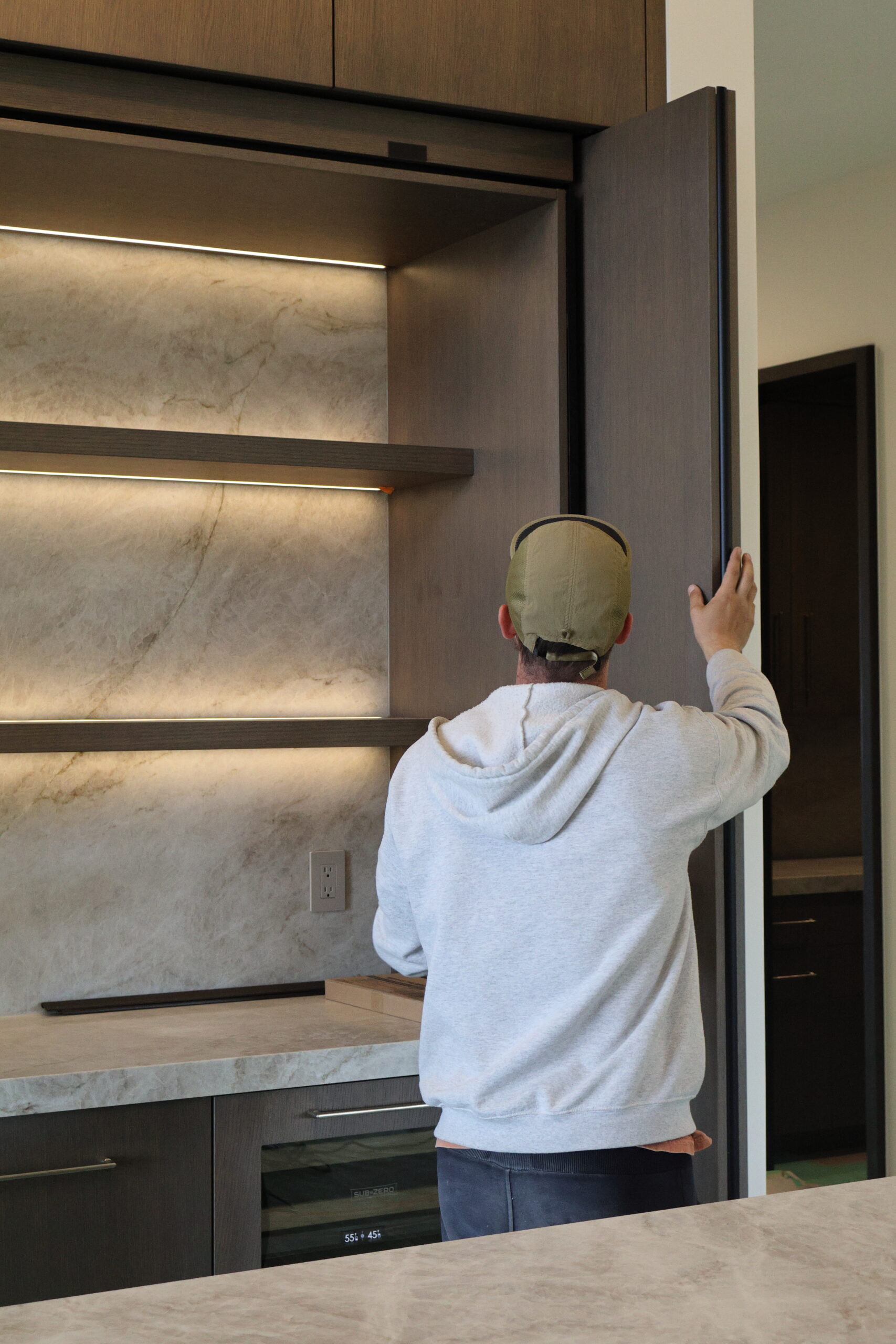
One major advantage of controlling manufacturing is the ability to inspect the cabinetry before it reaches the home.
Dimensions, finishes, hardware, doors, drawers, and other components can be checked as part of the production process.
That matters because discovering an issue in a workshop is very different from discovering it after cabinets have been delivered to a finished home.
The earlier an issue is identified, the more options there are for correcting it.
A well-controlled process moves quality control upstream rather than relying on the installer to discover everything on site.
Installation Is Part of the Cabinetry
A cabinet is not finished simply because it has been manufactured.
The installation affects alignment, reveals, door operation, panel placement, and how the cabinetry interacts with the surrounding architecture.
This is particularly important in luxury homes where cabinetry may sit directly beside stone, wall panels, appliances, flooring, doors, and other finished surfaces.
A strong installation team needs to understand the design intent.
When the manufacturer also handles installation, that team already knows what was intended and how the cabinets were constructed.
There is no need to start from zero when the cabinetry arrives at the home.
Full-Service Does Not Mean No Delays
It is important to be realistic.
Even the best full-service cabinetry company cannot control everything that happens on a construction site.
Other trades may run behind schedule.
A wall may change.
An appliance may be substituted.
A material may become temporarily unavailable.
A homeowner may decide to change part of the design.
These things can affect a timeline.
The advantage of full-service cabinetry is not that delays become impossible.
It is that the cabinetry team has more control over the parts of the process it is responsible for.
When an issue appears, there is also one team with the knowledge and responsibility to address it.
Changes Are Easier to Manage When the Team Knows the Project
Custom cabinetry often develops as the project moves forward.
A homeowner may realize that a storage feature would work better in a different location. An interior designer may refine a material. A builder may identify a site condition that affects the cabinetry.
Changes are sometimes necessary.
The timing matters.
A change made during design may be straightforward to incorporate. The same change after manufacturing has started can affect materials, production, and scheduling.
Because a full-service team is involved throughout the process, the impact of a change can be evaluated within the context of the entire project.
That allows the team to explain what needs to change, what it may affect, and when the decision needs to be made.
One Point of Accountability
Perhaps the simplest benefit of full-service cabinetry is accountability.
When design, manufacturing, and installation are handled by different companies, it can become difficult to determine where a problem originated.
Was the measurement incorrect?
Was the drawing interpreted incorrectly?
Was something manufactured incorrectly?
Was the installation different from the approved design?
With one company responsible for the cabinetry process, there are fewer places for that question to go.
The goal is not to assign blame.
It is to solve the problem.
One team can investigate what happened, determine the appropriate correction, and take responsibility for getting the cabinetry right.
Why This Matters for Interior Designers and Builders
Full-service cabinetry is also valuable for the professionals coordinating a larger project.
Interior designers can focus on the broader design while the cabinetry team manages cabinetry-specific details.
Builders can coordinate with one cabinetry team rather than managing separate design, manufacturing, and installation contacts.
This becomes even more useful on whole-home projects where cabinetry may include kitchens, pantries, bathrooms, laundry rooms, offices, bars, mudrooms, built-ins, and other spaces.
A single cabinetry partner can help maintain consistency across all of them.
Why It Matters Even More With European Cabinetry
European cabinetry relies heavily on precision.
Clean lines, frameless construction, integrated appliances, specialty hardware, and carefully planned storage leave little room for disconnected decisions.
A small change in one area can affect another.
That makes communication especially important.
At Euromax, European design principles are combined with fully custom manufacturing and in-house installation. This allows our team to follow the project from the first design decisions through the finished installation.
The goal is simple: keep the details connected.
Full Control Creates Better Communication
The biggest benefit of a full-service custom cabinetry approach may not be speed.
It is clarity.
Everyone involved understands what has been approved, what is being built, what needs to happen next, and who is responsible for each stage.
That does not make a custom project simple.
Full-service custom cabinetry still requires time, decisions, approvals, manufacturing, and careful installation.
In fact, the more customized the project, the more detail the process requires.
Full-service custom cabinetry simply gives those details one connected path from concept to completion.
What to Look for in a Full-Service Cabinetry Company
If you are considering a full-service cabinetry company, ask what “full service” actually includes.
Useful questions include:
- Is the cabinetry designed in-house?
- Who takes the final measurements?
- Who manufactures the cabinets?
- Where are the cabinets produced?
- Who controls the finishes and materials?
- Who performs quality control?
- Who installs the cabinetry?
- Who handles adjustments after installation?
- Who is your main point of contact?
- How are design changes handled?
- How does the cabinetry team coordinate with the builder or interior designer?
The answers can tell you much more than the phrase “full service” alone.
The Real Advantage Is Continuity
Full-service custom cabinetry is a chain of decisions.
The measurement affects the design.
The design affects manufacturing.
Manufacturing affects installation.
Installation determines how the finished cabinetry meets the actual home.
When those stages are separated, information has to cross from one team to another at every step.
When one team controls the process, those connections become much stronger.
That is the real value of full service custom cabinetry.
It does not promise a project without challenges.
Instead, it creates a process where the people responsible for the cabinetry understand the project from beginning to end—and have the ability to act when something needs attention.
For high-end custom homes, where materials, proportions, architectural details, and installation all matter, that continuity can make the difference between simply delivering cabinets and delivering a finished cabinetry system that feels completely integrated with the home.
 >
> >
> >
>